
"middle species"
2000 article(s) found
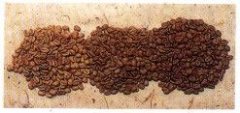
Boutique Coffee Information on Coffee beans
Small and round dark brown coffee beans, quietly emitting a fragrant fragrance in the grinder, injected into the cup showing the beautiful color of amber, these are the three very deep impressions of coffee. As you explore the history and beauty of coffee, you can also see the coffee trees that are caressed by the tropical sun and whose leaves twinkle. It has small white flowers similar to jasmine.

Comparison of parameters between Arabica and Robusta Coffee
Coffee beans are the seeds of Rubiaceae Family, under which there are at least 25 main varieties of the genus Coffea Genus.
Bolivia new Justa cooperative information introduction washing iron card species is very sweet!
For the exchange of professional baristas, please follow the coffee workshop (Wechat official account cafe_style) Bolivia Finca Nueva Llusta brief description 2017, Bolivia, the new Eusta cooperative tin card species! The new Justa Cooperative of Bolivia is located in San Lorenzo High altitude Valley (San Lorenzo). The achievement of the Excellence Cup in 2005 not only made the small farmers in the area famous, but also laid the foundation.

Coffee World Map-- the Evolution and planting History of Coffee beans in Indonesia
For professional baristas, follow the Coffee Workshop (Wechat official account cafe_style) Indonesia is made up of more than 17, 000 islands scattered over the equatorial volcanic belt and has fertile soil. Famous producing areas include Sumatra in the west, Sulawesi in the middle, and Java in the south. Coffee was brought to Jakarta in 1696 by the governor of the Netherlands from Malabar, India.

Introduction to the flavor and taste of the bright and fragrant Costa Rican Saint Roman Coffee Manor.
The topography of Costa Rica is that the coast is surrounded by plains, while the middle is cut off by rugged mountains. The country declared 200 nautical miles in its exclusive economic zone and 12 nautical miles in its territorial sea. The climate is tropical and subtropical, and there is also part of the new tropical Costa Rica, which accounts for only 0.03% of the world's land area, but has nearly 4% of the world's species, making it the country with the richest biological species in the world.
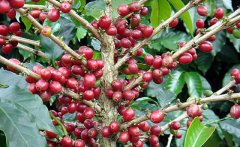
Fine coffee Arabica grows coffee beans
Arabica beans account for 70% of the world's output. The world-famous Blue Mountain Coffee and Mocha Coffee are almost all Arabica species. The other is the Robasta species, which is native to the Congo in Africa and accounts for about 20% to 30% of the world's output. Different varieties of coffee beans have different tastes, but even the same variety of coffee trees, due to different
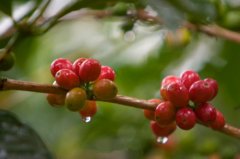
High-quality coffee, coffee, common sense, production of coffee beans.
Coffee in the ancient Middle East, like the legend of 1001 nights, like a veiled girl with a thousand faces, can not only help get close to God, but also wash the spring of sadness. When it comes to coffee, we have to mention Turkish coffee in the Middle East, because no matter from the perspective of Islam or Christianity, the origin of coffee is in the remote and mysterious Middle East. In the thirteenth to fifteenth centuries, it grew.

Robusta Coffee Flavor Description Features Variety Producing area Fine coffee beans Taste Manor Introduction
Robusta's coffee tree is a kind of tree between shrubs and tall trees, long leaves, bright green color, trees up to 10 meters tall, but the roots are very shallow, fruit is slightly rounder than Arabica coffee fruit, beans are flat round, the center pit is straight. Robusta species have a distinctive aroma (known as Rob flavor, some people mainly for being moldy odor) and bitterness, if taken 23

How to distinguish the basic knowledge of coffee from the specifications and grades of coffee beans
Small and round dark brown coffee beans, quietly emitting a fragrant fragrance in the grinder, injected into the cup showing the beautiful color of amber, these are the three very deep impressions of coffee. As you explore the history and beauty of coffee, you can also see the coffee trees that are caressed by the tropical sun and whose leaves twinkle. It has small white flowers similar to jasmine.
The production of coffee beans
Coffee in the ancient Middle East, like the legend of 1001 nights, like a veiled girl with a thousand faces, can not only help get close to God, but also wash the spring of sadness. When it comes to coffee, we have to mention Turkish coffee in the Middle East, because no matter from the perspective of Islam or Christianity, the origin of coffee is in the remote and mysterious Middle East. In the thirteenth to fifteenth centuries, it grew.
The growth experience of coffee
Coffee seedlings do not blossom until about 5 years. Coffee begins to wither after flowering for 2-3 days. Green fruit gradually turns yellow after a few months. In June-September, it begins to turn red. There are roughly three varieties of coffee grown on a large scale: Arabica, also known as Arabica, which accounts for about 70% of the world's coffee acreage. The bean shape is slender, with an S-shaped line in the middle, and is native to

A small, round, dark brown coffee bean.
Small and round dark brown coffee beans, quietly emitting a fragrant fragrance in the grinder, injected into the cup showing the beautiful color of amber, these are the three very deep impressions of coffee. As you explore the history and beauty of coffee, you can also see the coffee trees that are caressed by the tropical sun and whose leaves twinkle. It has small white flowers similar to jasmine.

Sidamo production area introduced by Coffee Tree Plantation
Variety classification Arabica bean coffee tree can be divided into two main varieties: Arabica species (Coffea Arabica) and Robusta species (Coffea Robusta/Coffea Canephora). There are also some minor species, such as the Liberian species (Coffea Liberica) and the Alabasta species (Coffea Arabusta), but they are rare on the market. Rob.
On the Origin, Culture and Communication of the History of Coffee
Coffee tree, is a tropical plant, is an evergreen shrub, growing in the equator, latitude 25 degrees north and south, that is, within the Tropic of Cancer. The Tropic of Cancer and near the equator are the world coffee growing belts. The growth conditions require abundant rainfall and humid climate. The suitable altitude is about 600 to 1500 meters, and the annual rainfall is 1500 to 2000 millimeters. Mild days alternate with cool nights.

Comparison of flavor and taste of Ethiopian coffee: Yega Xuefei and Sidamo
Professional coffee knowledge exchange more coffee bean information Please follow the coffee workshop (Wechat official account cafe_style) Ethiopians have a passion for coffee, with an annual per capita coffee consumption of 3 kg. Ethiopia ranks first in terms of coffee consumption in Africa and, if compared with European countries, can also rank among the top-middle coffee consuming countries in Europe. Now, Esther.

Medium fruit coffee robusta coffee
Follow Cafe (Wechat official account vdailycom) found that Beautiful Cafe opened a small shop of its own Robusta species (scientific name Coffee Robusta Linden). The leaf rust-resistant varieties found in Congo in Africa have stronger disease resistance than Arabica. In the general coffee market, many people like to compare robusta coffee beans with Arabica coffee beans, which is incorrect.
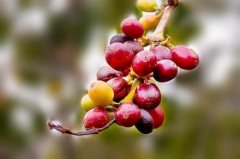
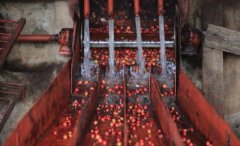
Production and processing of coffee beans treatment of high-quality coffee beans
Coffee in the ancient Middle East, like the legend of 1001 nights, like a veiled girl with a thousand faces, can not only help get close to God, but also wash the spring of sadness. When it comes to coffee, we have to mention Turkish coffee in the Middle East, because no matter from the perspective of Islam or Christianity, the origin of coffee is in the remote and mysterious Middle East. In the thirteenth to fifteenth centuries, it grew.

Growth environment, characteristics and development status of Robusta coffee beans
The output of Robusta species accounts for 25% 35% of coffee bean production, and its main producing countries are in Indonesia (one of its coffee beans is a kind of coffee beans processed by washing, which is a hybrid between Robusta and Arabica. It is the only kind of coffee beans on the Chinese market that can be used as a single drink), Vietnam, Africa, (Ivory Coast, Nigeria, Angola)

Ethiopia Yega Chuefefen washing Yega native species Waka WorkaG1 has a rich citrus flavor
Boutique coffee (specialty coffee) is also called specialty coffee selection coffee. It refers to coffee made from a small number of raw beans with excellent taste grown in an ideal geographical environment. Depending on the special soil and climatic conditions in which they grow, they have outstanding flavor. After strict selection and classification, this kind of coffee is hard in texture, rich in taste and stylish.
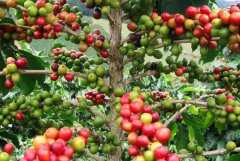
Do you know anything about Arabica's fine beans?
Arabica beans account for 70% of the world's output. The world-famous Blue Mountain Coffee and Mocha Coffee are almost all Arabica species. The other is the Robasta species, which is native to the Congo in Africa and accounts for about 20% to 30% of the world's output. Different varieties of coffee beans have different tastes, but even the same variety of coffee trees, due to different